Environments
This page lists and describes the environments included with craftium.
Note
Although craftium is a reinforcement learning environment creation framework, it comes with some predefined environments ready to use and whose implementations can also serve as inspiration for creating new ones. Check mods/craftium_env inside the directory of every environment in the repo.
"Classic" RL tasks
Chop tree 🪓
The player spawns in a dense forest with many trees, equipped with a steel axe. Every time the player chops a tree a positive reward of 1.0 is given, otherwise the reward is 0.0.

-
Import:
gymnasium.make("Craftium/ChopTree-v0") -
Observation space:
Box(0, 255, (64, 64, 3), uint8)(64x64 RGB image) -
Action space:
Discrete(8)(nop,forward,jump,dig(used to chop),mouse x+,mouse x-,mouse y+,mouse y-) -
Default episode length: 2000
-
Reward range: {0.0, 1.0}
Room 🏃
The player is placed at one end of a closed room. In the other half of the room, a red block is spawned. The objective is to reach the red block as fast as possible. At every timestep the reward is set to -1, and when the player reaches the block the episode terminates. The positions of the player and the red block are randomized and change in every episode, thus the agent cannot memorize the target's position.

-
Import:
gymnasium.make("Craftium/Room-v0") -
Observation space:
Box(0, 255, (64, 64, 3), uint8)(64x64 RGB image) -
Action space:
Discrete(4)(nop,forward,mouse x+,mouse x-) -
Default episode length: 2000
-
Reward range: {-1}
Small room 🏃
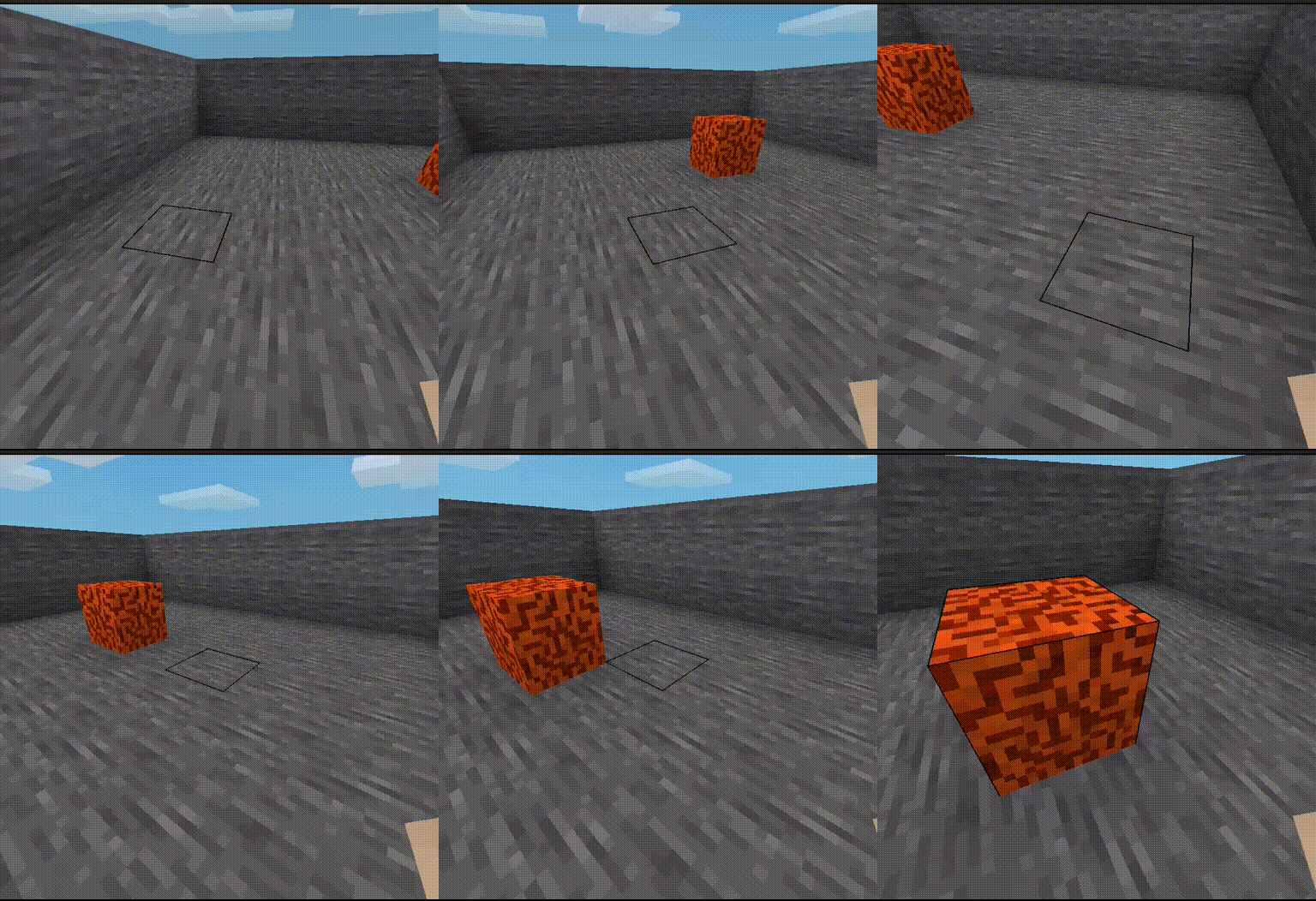
The same as Craftium/Room-v0 but in a smaller room, resulting in a considerably easier task (less sparse). However, note that the default episode length is shorter than in the previous environment.
-
Import:
gymnasium.make("Craftium/SmallRoom-v0") -
Observation space:
Box(0, 255, (64, 64, 3), uint8)(64x64 RGB image) -
Action space:
Discrete(4)(nop,forward,mouse x+,mouse x-) -
Default episode length: 1000
-
Reward range: {-1}
Speleo 🦇
In this environment, the player spawns in a closed cave illuminated with torches. The objective is to reach the bottom of the cave as fast as possible. For this purpose, the reward at each timestep is the negative Y-axis position of the player (the reward gets more positive as the player goes deeper into the cave).

-
Import:
gymnasium.make("Craftium/Speleo-v0") -
Observation space:
Box(0, 255, (64, 64, 3), uint8)(64x64 RGB image) -
Action space:
Discrete(7)(nop,forward,jump,mouse x+,mouse x-,mouse y+,mouse y-) -
Default episode length: 3000
-
Reward range: [-8.8, 24.5]
Spiders attack 🕷️
The player is spawned in a closed cage with a spider inside it. The player is equipped with a steel sword, and the objective is to kill as many spiders as possible until the end of the episode. Every time the player kills a spider the reward of that timestep is set to 1.0, and 0.0 otherwise. Moreover, when all spiders inside the cage are dead, spiders are respawned with one more spider than in the previous round. The episode terminates if the player is dead or if it survives the last round (with 5 spiders).

-
Import:
gymnasium.make("Craftium/SpidersAttack-v0") -
Observation space:
Box(0, 255, (64, 64, 3), uint8)(64x64 RGB image) -
Action space:
Discrete(10)(nop,forward,left,right,jump,dig(attack),mouse x+,mouse x-,mouse y+,mouse y-) -
Default episode length: 4000
-
Reward range: {0.0, 1.0}
Open world
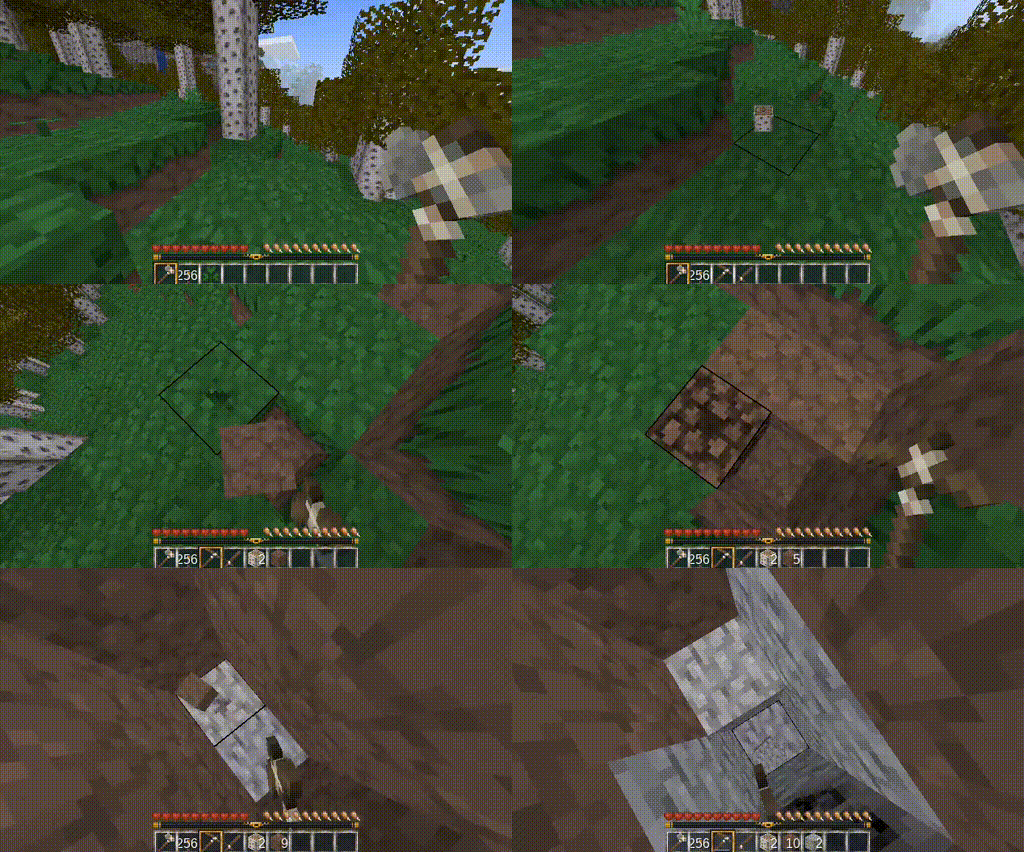
The player has to survive and gather resources in an open world (VoxeLibre). The environment is designed to have three different tracks: tools, hunt, and defend. Each track has milestones and rewards, ordered in a hierarchical tree of skills.
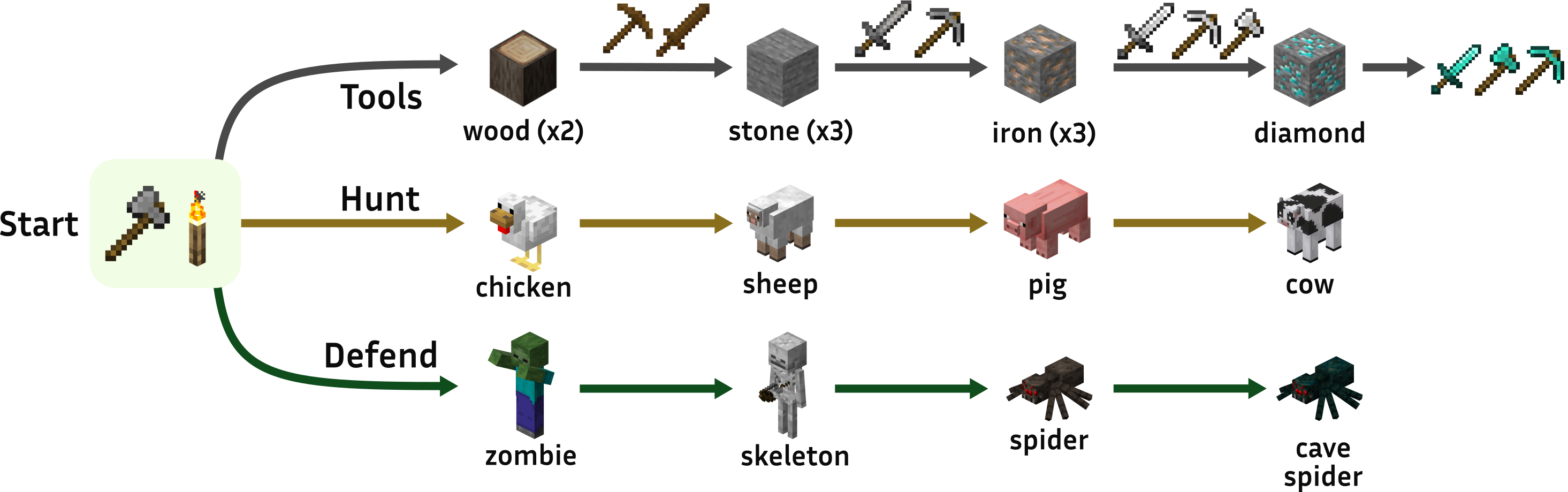
Every time the player unlocks a milestone in any of the tracks, it receives a reward corresponding to the unlocked skill. The milestones and their rewards are:
-
Tools track:
- T1: Collect two wood blocks. When completed, a reward of 128 is given and the player obtains a wood pickaxe and sword.
- T2: Collect three stone blocks. When completed, a reward of 256 is given and the player obtains a stone pickaxe and sword.
- T3: Collect three iron blocks. When completed, a reward of 1024 is given and the player obtains an iron pickaxe, axe, and sword.
- T4: Collect a diamond block. When completed, a reward of 2048 is given and the player obtains a diamond pickaxe, axe, and sword.
-
Hunt track: The player is rewarded every time it hunts an animal. The world is populated with chickens, sheep, pigs, and cows, and the reward for hunting them is 16, 32, 64, and 128 respectively.
-
Defend track: The player is rewarded every time it kills a monster. The world is populated with zombies, skeletons, spiders, and cave spiders, and the reward for killing them is 32, 64, 128, and 256 respectively.
In Luanti, the time of day of the game is linked to the real clock time, where the day/night cycle lasts for 20 minutes by default (see this wiki page). In this environment, the time of day is set according to the global timestep to maintain consistency and avoid relaying in "real" clock time while training RL agents.
Additional information:
-
Import:
gymnasium.make("Craftium/OpenWorld-v0") -
Observation space:
Box(0, 255, (180, 320, 3), uint8)(64x64 RGB image) -
Action space:
Discrete(18)(nop,forward,backward,left,right,jump,sneak,dig,place,slot_1,slot_2,slot_3,slot_4,slot_5,mouse x+,mouse x-,mouse y+,mouse y-) -
Default episode length: 10k
-
Reward range: {0.0, 2048}
Procedural environment generation

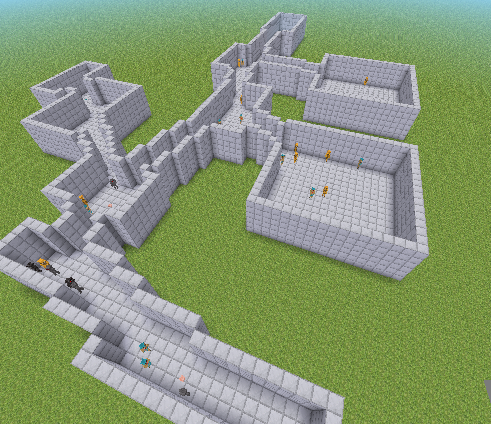
This environment showcases the flexibility of Craftium by implementing procedurally generated environments and tasks. These environments can be used for less conventional RL research such as unsupervised environment design, continual RL, and meta-RL.
In this case, craftium builds a dungeon environment specified by an ASCII map representation. ASCII maps can be defined by hand or (more interestingly) generated using a procedural map generator. Craftium provides a map generator class RandomMapGen (check the reference here), but you could use your own. Although the parameters of the reward function can be changed (see the section below), generally, the objective is to survive in a labyrinthic dungeon full of monstrous creatures and reach the objective (a diamond by default).
This environment uses the following Luanti mods: Superflat, mobs, and mobs_monster. Refer to the mods' documentation for further information (e.g., available monsters).
General information:
-
Import:
gymnasium.make("Craftium/ProcDungeons-v0") -
Observation space:
Box(0, 255, (64, 64, 3), uint8)(64x64 RGB image) -
Action space:
Discrete(10)(nop,forward,left,right,jump,dig(attack),mouse x+,mouse x-,mouse y+,mouse y-) -
Default episode length: 5_000
-
Reward range: Specified by the developer.
Environment initialization
Instantiating the environment using the default parameters (i.e., gymnasium.make("Craftium/ProcDungeons-v0")) will always initialize the same default map. Use the ascii_map parameter to change the map. You can (optionally) generate random maps with ProcMapGen or use the built-in make_dungeon_env function.
For simplicity, craftium includes a built-in utility function (see make_dungeon_env) to generate this type of environments, avoiding bilerplate code. Here are some examples of how to use it:
# Generate a random dungeon using the default values
env = craftium.make_dungeon_env()


# Make a random map, return it, and set the render_mode
# of the CraftiumEnv to "human"
env, map_str = craftium.make_dungeon_env(
    return_map=True,
    render_mode="human",
)


# Generate a random map using RandomMapGen and pass it to make_dungeon_env
from craftium.extra.random_map_generator import RandomMapGen
mapgen = RandomMapGen(n_rooms=10)
ascii_map = mapgen.rasterize(wall_height=7)
env = craftium.make_dungeon_env(ascii_map)


# Generate a random dungeon, customizing RandomMapGen arguments,
# changing the wall_material to obsidian, and modifying general
# CraftiumEnv arguments
env, map_str = craftium.make_dungeon_env(
    mapgen_kwargs=dict(
        n_rooms=2,
        room_max_size=12,
    ),
    return_map_str=True,
    render_mode="human",
    obs_width=512,
    obs_height=512,
    minetest_conf=dict(
        wall_material="default:obsidian",
    ),
)
print(map_str)
Custom parameters
This environment expects some parameters when initialized. These parameters are specified using the mintest_conf keyword parameter when calling gymnasium.make. Here's an example:
import gymnasium as gym
import craftium
from craftium.extra.random_map_generator import RandomMapGen

# Generate a random map using the random dungeon generator provided by craftium
mapgen = RandomMapGen(
        n_rooms=5,
        dispersion=0.4,
        room_min_size=5,
        room_max_size=10,
        max_monsters_per_room=5,
        monsters={"a": 0.4, "b": 0.3, "c": 0.2, "d": 0.1},
    )

ascii_map = mapgen.rasterize(wall_height=5)  # Convert map into a string

env = gym.make(
    "Craftium/ProcDungeons-v0",
    minetest_conf=dict(
        give_initial_stuff=True,
        initial_stuff="default:sword_steel",  # Provide the player with a sword
        performance_tradeoffs=True,
        # ProcDungeons-v0 specific:
        monster_type_a="mobs_monster:sand_monster",
        monster_type_b="mobs_monster:spider",
        monster_type_c="mobs_monster:stone_monster",
        monster_type_d="mobs_monster:mese_monster",
        wall_material="default:steelblock",
        objective_item="default:diamond",  # item to serve as objective
        rwd_objective=100.0,  # Reward of collecting the objective item
        rwd_kill_monster=1.0,  # Reward for killing a monster
        ascii_map=ascii_map.replace("\n", "\\n"),
    ),
)
The required parameters are:
| Parameter | Description |
|---|---|
monster_type_a |
Name of the type a monster |
monster_type_b |
Name of the type b monster |
monster_type_c |
Name of the type c monster |
monster_type_d |
Name of the type d monster |
wall_material |
Name of the material to use for construction |
objective_item |
itemstring of the item to use as objective |
rwd_objective |
Reward for reaching the objective |
rwd_kill_monster |
Reward for killing a monster |
ascii_map |
Map specification in ASCII format (see section below) |
Map format specification
Maps are specified as ASCII strings, where each character has a different meaning. Maps are organized into layers, where the first layer is the floor layer, the second includes walls, the player, and monsters, and the rest of the layers are used for walls.
| Character | Meaning |
|---|---|
| (whitespace) | Air block |
# |
Wall or floor block (wall_material) |
@ |
Player |
O |
Objective item (objective_item) |
a, b, c, and d |
Monsters of types a, b, c, and d |
- |
New layer |
An example map with three layers (walls have a height of 2 blocks). The map describes a dungeon of two rooms, with a single objective item and a monster of type b.
##########
##########
##########
##########
##########
      #####
       #####
       ##########
       ##########
       ##########
       ##########
       ##########
-
##########
#        #
#    @   #
#        #
######   #
      #   #
       #   #
       #    #####
       #        #
       #    O   #
       #      b #
       ##########
-
##########
#        #
#        #
#        #
######   #
      #   #
       #   #
       #    #####
       #        #
       #        #
       #        #
       ##########
This ASCII map is transalted to the following craftium environment:
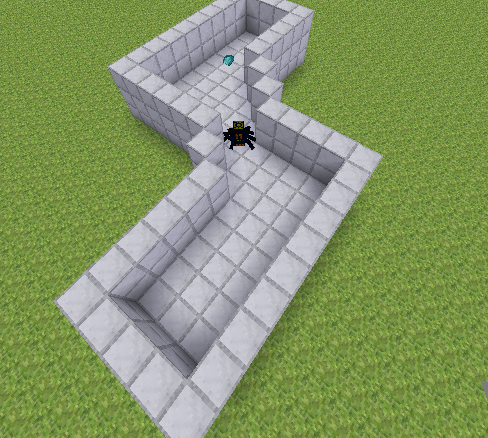
In this case, the objective_item was set to default:diamond, and monster_type_b to mobs_monster:spider.
Continual RL
Craftium also provides a task sequence for Continual Reinforcement Learning (CRL), built using the Craftium/ProcDungeons-v0 procedural environment. In CRL, the agent faces a discrete sequence of tasks, where the agent only operates in one task at a time and the time in each task is limited. In this context, the agent's objective is to learn new tasks as efficiently as possible, using the knowledge generated in previously faced tasks to solve new ones.
Craftium provides a ready-to-use sequence of tasks for CRL, but can also be used for curriculum learning or meta-R. Currently craftium ships with a single sequence, named sequence0_25, with 25 different tasks.
Tasks can be loaded using the load_task function in extras:
import craftium.extra.crl_dungeons as crl

env = crl.load_task("sequence0_25", task_id=0)  # Load the first task from sequence0
Check the reference for more information on load_task. In the future, craftium might include other task sequences of different lengths and properties, but will also be accessible through the load_task function. This function also allows to preview a task by returning the ASCII format of the map. For example, to preview the map of the 6th task of sequence0_25:
ascii_map = crl.load_task("sequence0_25", task_id=5, make_env=False, return_map=True)
print(ascii_map.split("-")[1])
The output:
#######
#     #
# a   #
#     #
#     #
####   #
    #   #
     #   #
      #   #####
       #      #
        #     #
        #  @  #
        #     #
        ####   #
            #   #
             #   #
              #   #
               #   #
                #   #####
                 #      #
                  # b   #
                  #  O  #
                  #     #
                  #######
The map of this task consist of three vertically placed rooms. The agent starts from the center room, the upper room only contains a monster of type A, and the bottom room holds a type B monster and the objective item (O character).
The rest of the tasks can be previewd using the same method, or can be directly accessed in the repository (check the single text file containing all the maps). The properties of each task in the sequence are given in the figures below:
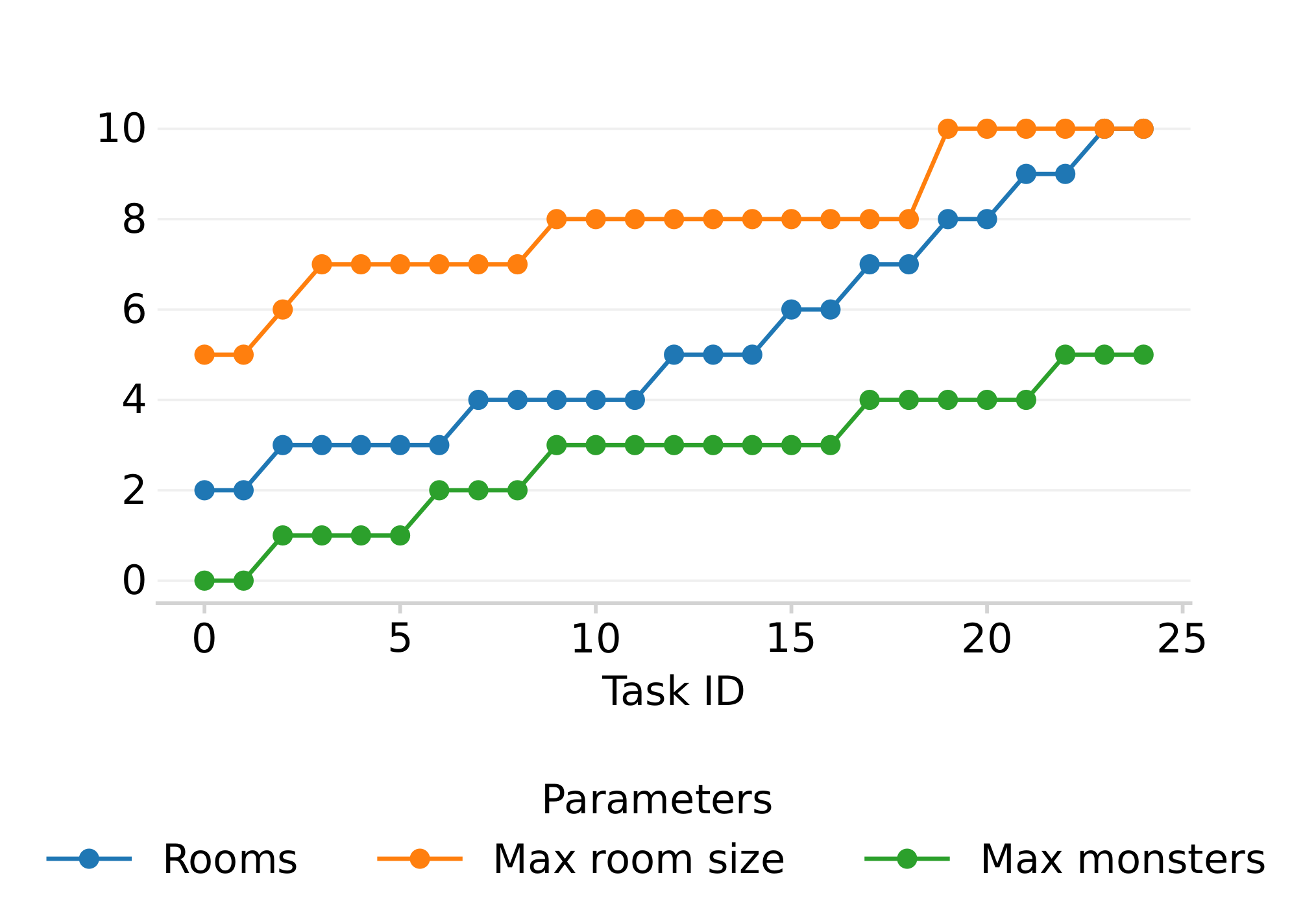
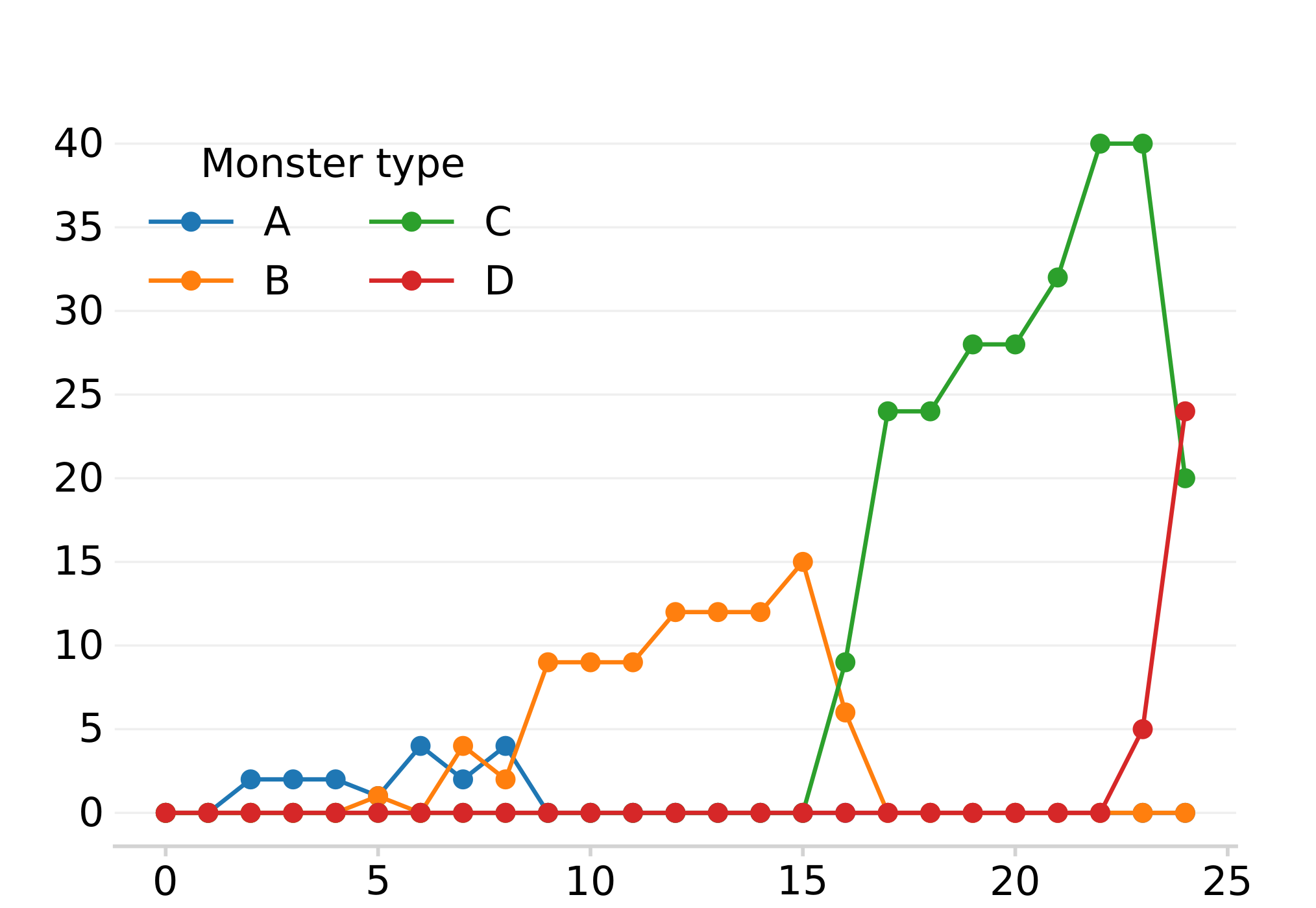
Note that the lower figure counts the number of monsters on the map, but the maximum number of monsters per room has been set to 5 for the most difficult tasks, and lower for the rest (check the upper figure).